


Divorce Process in Nepal
-
 By Attorney Nepal
 - Divorce law in Nepal
- Oct 28, 2025
- 23 minutes read
- 804 Views
With divorce rates in Nepal increasing by 23% since 2018, understanding the legal process has never been more crucial for protecting your rights and future. Navigating the divorce process in Nepal requires understanding complex legal procedures, documentation requirements, and timelines established under the Muluki Civil Code 2017.
Understanding the Divorce Process in Nepal: A Complete Legal Guide for 2025
With divorce rates in Nepal increasing by 23% since 2018, understanding the legal process has never been more crucial for protecting your rights and future. Navigating the divorce process in Nepal requires understanding complex legal procedures, documentation requirements, and timelines established under the Muluki Civil Code 2017. Whether you're considering mutual consent divorce or filing independently, this comprehensive guide provides accurate, actionable information to help you understand your rights and obligations throughout the divorce procedure in Nepal.
This guide will save you time, money, and emotional stress by providing insider knowledge that many lawyers don't share upfront. In this comprehensive guide, you'll discover: the exact timeline for your divorce, how to protect your financial interests, and strategies to minimize conflict while maximizing your legal position.
Divorce Lawyer in Nepal
Advocate Miss Aastha Lohanee has professional experience in Divorce Process in Nepal. She has been consulting client in divorce process as well as is expert in divorce law.

What is Divorce in Nepal?
Divorce in Nepal represents the legal dissolution of marriage between husband and wife, formally ending marital obligations and restoring both parties to single status. The divorce process in Nepal operates under Chapter 3 of the Civil Code 2017 (Sections 93-104), which governs all aspects of marital dissolution including grounds, procedures, property division, and child custody arrangements.
The Muluki Civil Code 2017, which became effective on August 17, 2018, revolutionized divorce law in Nepal by introducing mutual consent provisions and equalizing rights between spouses. Importantly, both husband and wife now possess equal legal standing to initiate divorce proceedings in Nepal, representing a significant shift from previous legislation that limited divorce rights primarily to women.
Key Legal Framework
The divorce procedure in Nepal follows these fundamental principles:
- Unified application: One civil law applies to all Nepali citizens regardless of religion, caste, or ethnicity
- Equal rights: Both spouses can initiate divorce independently
- Mutual consent option: Couples agreeing to separate can divorce quickly without proving fault
- Property protection: Mandatory property division before divorce finalization ensures financial fairness
- Child welfare priority: Custody decisions prioritize children's best interests
Types of Divorce in Nepal
Understanding the types of divorce in Nepal helps you choose the appropriate legal pathway based on your circumstances.
1. Divorce by Mutual Consent
Mutual consent divorce represents the fastest, most economical option when both spouses agree to end their marriage. Under Section 93 of the Civil Code, couples can terminate their relationship at any time through mutual agreement without establishing fault or specific grounds.
Timeline for mutual consent divorce: 2-3 working days
Estimated cost: NPR 2,000 - 10,000
Court proceedings: Minimal
How Mutual Consent Divorce Works
The mutual divorce process in Nepal follows these streamlined steps:
- Joint petition preparation: Both spouses collaborate on a single petition stating mutual agreement to divorce
- Agreement on key issues: Couples must resolve property division, child custody arrangements, and alimony before filing
- District Court filing: Submit joint petition with supporting documents to the District Court where either spouse resides
- Court review: Judge examines the petition and supporting documentation
- Immediate decree: If all requirements are met, the court grants divorce the same day or within 2-3 working days
Advantages of mutual consent divorce:
- Significantly faster than contested divorce
- Lower legal costs and court fees
- Reduced emotional stress and conflict
- Privacy protection with minimal public proceedings
- Greater control over settlement terms
2. Divorce Without Mutual Consent (Contested Divorce)
When spouses cannot agree, either party can file for divorce in Nepal independently by establishing legal grounds. This contested divorce process requires proving specific conditions outlined in Sections 94 and 95 of the Civil Code.
Timeline for contested divorce: Minimum 1 year, typically 1.5-3 years
Estimated cost: NPR 30,000 - 100,000+
Court proceedings: Extensive
3. Automatic Divorce Situations
Certain circumstances trigger automatic dissolution of marriage under Nepal law:
- Marriage without full consent: If either party was coerced or lacked capacity to consent
- Incestuous marriages: Relationships subject to legal punishment automatically dissolve
- Wife's remarriage before divorce completion: Previous marriage automatically ends
Legal Grounds for Divorce in Nepal
The grounds for divorce in Nepal differ slightly between husband and wife, though both possess substantial rights to seek marital dissolution.
Grounds for Husband to File Divorce
Under Section 94 of the Civil Code 2017, a husband may initiate the divorce process in Nepal under these circumstances:
Important consideration: If divorce occurs due to wife's actions under grounds (b), (c), or (d), the husband is not compelled to provide property partition or alimony.
Grounds for Wife to File Divorce
Section 95 of the Civil Code provides wives with broader grounds, reflecting gender equality protections:
Critical note: These grounds provide wives with stronger protections against domestic violence, abandonment, and marital misconduct.
Step-by-Step Divorce Procedure in Nepal
The divorce procedure in Nepal follows a structured legal process designed to ensure fairness while encouraging reconciliation where possible.
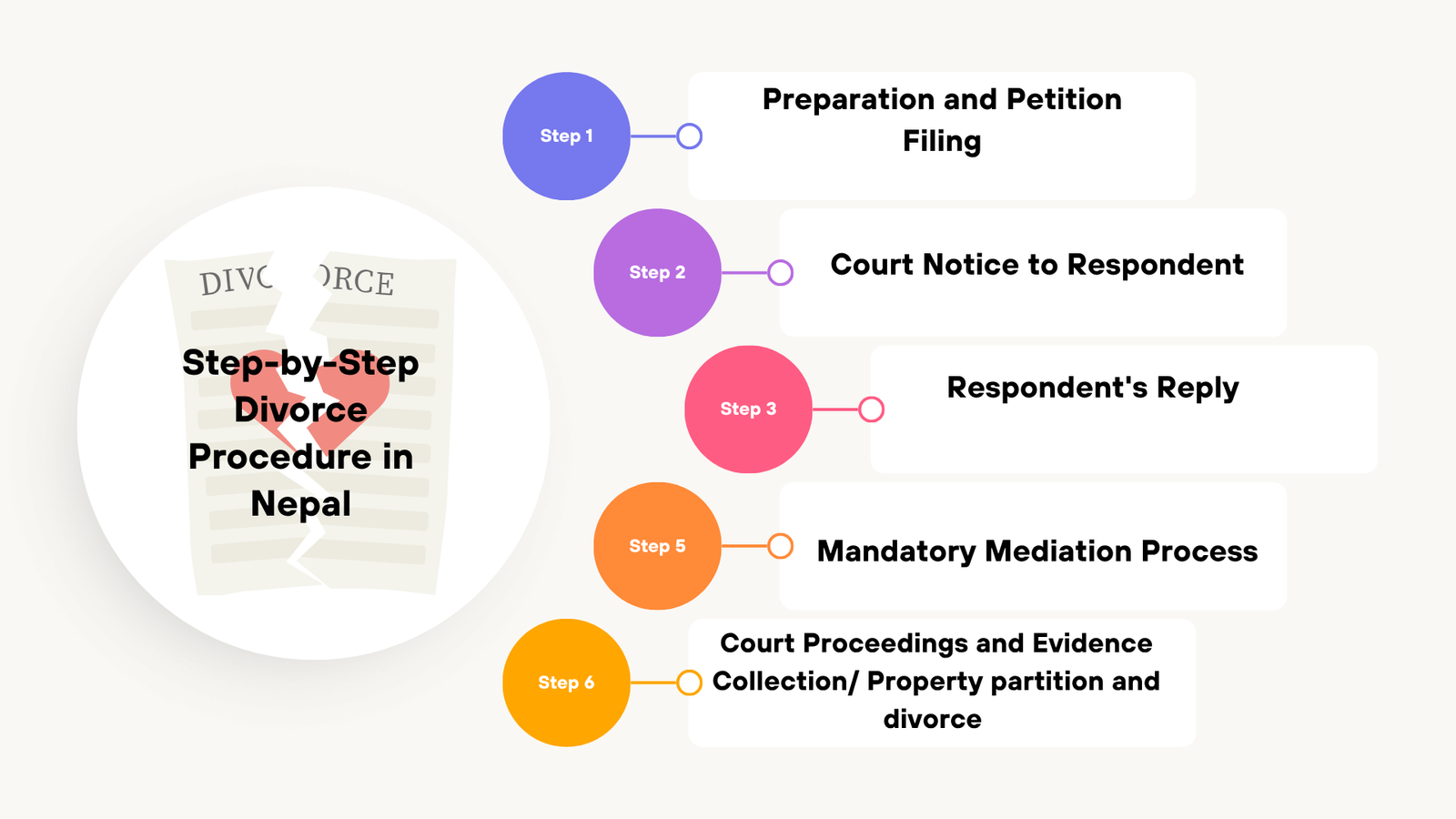
Step 1: Preparation and Petition Filing
For Mutual Consent Divorce:
- Draft joint petition signed by both spouses
- Prepare settlement agreement covering property, custody, and alimony
- Gather all required documents (listed below)
- File at District Court where either spouse resides
For Contested Divorce:
- Petitioner (plaintiff) files individual divorce petition
- Clearly state legal grounds with supporting evidence
- Identify all assets, properties, and custody considerations
- Submit to District Court with appropriate jurisdiction
Court fee: NPR 500 for divorce petition
Plaint paper fee: NPR 200
Application fee: NPR 10
Step 2: Court Notice to Respondent
After accepting the petition, the District Court issues formal notice to the respondent (defendant) through official court channels. The respondent receives:
- Copy of divorce petition
- Timeline for response (typically 21 days)
- Information about rights and obligations
- Date for initial court appearance
Timeline: 7-15 days after filing for notice delivery
Step 3: Respondent's Reply
The respondent must file a written reply within the court-specified timeframe, which should include:
- Acceptance or rejection of divorce claims
- Counter-claims regarding property or custody
- Evidence supporting their position
- Any demands for alimony or financial support
Defense paper fee: NPR 200
Consequences of non-response: The court may proceed with the case even if the respondent fails to reply, though extensions can be granted for valid reasons.
Step 4: Mandatory Mediation Process
Nepal's divorce law requires courts to attempt reconciliation before granting divorce. During mediation:
- Both parties meet with court-appointed mediator
- Mediator encourages couple to resolve disputes amicably
- Discussion covers all contentious issues including property and custody
- Multiple mediation sessions may occur
Mediation objectives:
- Encourage marriage preservation where possible
- Facilitate settlement of property and custody disputes
- Reduce adversarial court proceedings
- Provide counseling resources
Important provision: Even if mediation fails to save the marriage, settlements reached on property division or custody during mediation are binding.
Step 5: Court Proceedings and Evidence Collection
If mediation fails to reconcile the marriage, formal court proceedings begin:
Trial preparation:
- Both parties present evidence supporting their claims
- Witnesses may testify regarding grounds for divorce
- Financial documents establish asset values
- Character witnesses may address custody suitability
Court hearings:
- Judge hears arguments from both sides
- Evidence is examined and cross-examined
- Property valuations are assessed
- Child custody evaluations may be ordered
Timeline: After mediation failure, the court must wait one year from the filing date before granting contested divorce (except mutual consent cases).
Step 6: Property Partition Before Divorce
Under Section 99 of the Civil Code, property division represents a mandatory prerequisite to divorce finalization. This critical step ensures neither party suffers financial disadvantage.
Property Division Rules
Equal entitlement principle: Wife and husband receive equal shares of marital property. For partition purposes, husband, wife, father, mother, son, and daughter are deemed coparceners (joint property owners).
Three property division scenarios:
- Jointly registered property: If property is registered in both names or either name, partition occurs according to law before divorce
- Undivided ancestral property: If husband hasn't obtained partition from his father or coparceners, court requires disclosure of all coparceners and facilitates partition
- No divisible property: If husband has no property but has income, court may order monthly maintenance instead
Timeline considerations: If property partition will require extended time, the court may:
- Grant divorce first
- Order husband to provide monthly alimony to wife
- Continue partition proceedings separately
- Base alimony on husband's property and income
Exception: Wife loses partition rights if divorce results from her actions under grounds specified in Section 94(b), (c), or (d).
Step 7: Final Divorce Decree
After addressing all legal requirements, the court issues the final divorce judgment including:
- Official dissolution of marriage
- Property division orders
- Child custody arrangements
- Alimony or maintenance obligations
- Timeline for compliance with orders
Court decision factors:
- Whether reconciliation is possible
- Fairness of property distribution
- Best interests of children
- Financial circumstances of both parties
- Evidence supporting divorce grounds
Step 8: Marriage Certificate Cancellation
Final administrative step requires:
- Recording divorce decree in official register
- Canceling marriage registration certificate
- Submitting final court order to Ward Office
- Updating civil status to "divorced"
- Obtaining single status certificate for future remarriage
Important: Without proper cancellation, individuals may face complications with remarriage, property transactions, or legal documentation.
Required Documents for Divorce in Nepal
Proper documentation ensures smooth processing of your divorce petition in Nepal.
Essential Documents for All Divorce Cases
Additional Documents for Specific Situations
For contested divorce:
- Evidence supporting grounds (medical reports, police reports, witness statements)
- Financial statements and income proof
- Property ownership documents and valuations
- Communication records (if relevant to grounds)
For divorce from abroad:
- Power of Attorney authenticated by Nepal Embassy
- Proof of current residence abroad
- Valid passport copies
- Authorization for representative in Nepal
For temporary residence situations:
- Temporary residence certificate from local Ward Office
- Recommendation letter from ward authorities
- Proof of temporary address
Professional tip: Organize all documents before filing to avoid delays. Missing documentation can significantly extend the divorce process timeline in Nepal.
Timeline for Divorce Process in Nepal
Understanding realistic timelines helps manage expectations during the divorce procedure in Nepal.
Mutual Consent Divorce Timeline
Speed factors: Mutual consent divorce represents the fastest option, often completing within a single week when all paperwork is properly prepared.
Contested Divorce Timeline
Factors affecting timeline:
- Court backlog and caseload
- Complexity of property division
- Custody dispute intensity
- Respondent cooperation level
- Evidence gathering challenges
- Appeals or procedural objections
Strategic consideration: The one-year mandatory waiting period for contested divorce cannot be waived, making mutual consent significantly faster when possible.
Cost Breakdown: Divorce Expenses in Nepal
Understanding financial implications helps you budget for the divorce process in Nepal.
Government Court Fees (Fixed)
Legal Professional Fees (Variable)
Mutual consent divorce lawyer fees: NPR 5,000 - 20,000
- Simple cases with agreement
- Minimal court appearances required
- Document preparation and filing
Contested divorce lawyer fees: NPR 30,000 - 300,000+
- Depends on case complexity
- Multiple court appearances over years
- Evidence collection and witness preparation
- Appeals and motions
Factors influencing lawyer fees:
- Geographic location (Kathmandu typically higher)
- Lawyer's experience and reputation
- Case complexity and property values
- Duration of proceedings
- Number of court appearances required
Additional Expenses
Document preparation: NPR 2,000 - 10,000
- Notarization and certification
- Translation services if needed
- Property valuation reports
Power of Attorney (for foreign residents): NPR 5,000 - 15,000
- Embassy authentication fees
- Courier charges between countries
- Representative appointment costs
Total estimated costs:
- Mutual consent divorce: NPR 5,000 - 25,000
- Contested divorce: NPR 50,000 - 150,000+
Cost reduction strategies:
- Pursue mutual consent when possible
- Handle simple procedures yourself
- Choose affordable yet competent legal counsel
- Attend court dates personally to minimize lawyer appearances
- Reach property settlements during mediation
Property Division and Alimony in Nepal Divorce
The divorce property division laws in Nepal ensure equitable distribution while protecting vulnerable spouses.
Property Partition Principles
Equal division standard: Under the Civil Code 2017, spouses receive equal shares of marital property. This represents significant progress in gender equity, particularly protecting wives' financial interests.
What constitutes marital property:
- Property acquired during marriage
- Joint investments and savings
- Business assets developed together
- Real estate purchased with marital funds
- Inherited property may be excluded depending on circumstances
Three partition scenarios:
- Registered joint property: Division follows legal procedures with court supervision ensuring equal distribution
- Property in single name: Still considered marital property subject to equal division
- Undivided ancestral property: Court orders disclosure of coparceners and facilitates proportional distribution
Timing requirement: Property partition must occur before or during divorce proceedings. Critical rule: Wife cannot claim property after divorce finalization, making timely action essential.
Exceptions to wife's property rights:
Under Section 100 of the Civil Code, the wife forfeits property claims when divorce results from:
- Wife depriving husband of maintenance or expelling him
- Wife causing grievous physical or mental harm to husband
- Wife engaging in extramarital sexual relations
Alimony and Maintenance Provisions
When property division proves insufficient or impossible, Nepal law provides alternative financial protections.
Lump Sum or Periodic Alimony
Section 100 provisions: Wife may request instead of property partition:
- Lump sum payment based on husband's total assets
- Annual alimony payments
- Monthly maintenance expenses
Court determination factors:
- Husband's total property value
- Husband's income and earning capacity
- Wife's financial needs and circumstances
- Duration of marriage
- Standard of living during marriage
- Wife's earning potential
Important limitation: Alimony ceases if wife remarries.
Maintenance When No Property Exists
Section 101 addresses: Situations where husband has no divisible property but earns income.
Court may order:
- Monthly maintenance payments
- Amount based on husband's income
- Consideration of wife's needs
Exceptions to maintenance obligation:
- Wife's income exceeds husband's income
- Wife remarries
- Husband has no earning capacity
Duration: Typically continues until wife's remarriage or change in financial circumstances, though specific timeframes may be court-determined.
Property Rights After Divorcee's Death
Section 102 addresses inheritance of divorced woman's property:
If divorcee has children: Son and daughter inherit her property equally
If divorcee has no children:
- Property received from ex-husband returns to ex-husband
- Property from maternal side goes to maternal successors
- Self-acquired property follows general inheritance rules
Practical implication: This provision discourages premature property transfer and protects both former spouses' interests.
Child Custody After Divorce in Nepal
The child custody laws in Nepal prioritize children's welfare while considering age-appropriate care arrangements.
Custody Determination Framework
Section 115 of the Civil Code 2017 establishes clear custody guidelines:
Age-Based Custody Rules
Key principles:
- Mother's remarriage below age 5: Does NOT affect custody rights
- Mother's remarriage above age 5: Child typically goes to father
- Child's opinion: Mandatory consideration for children over 10 years
- Best interest standard: Courts can deviate from defaults for child's welfare
Parental Agreement on Custody
Section 115(2) allows flexibility: If spouses create a separate custody agreement during divorce or judicial separation, that agreement governs custody arrangements.
Agreement benefits:
- Provides predictability and stability
- Allows creative custody sharing arrangements
- Respects parents' knowledge of children's needs
- Reduces conflict and litigation
Agreement requirements:
- Must be in writing
- Submitted to court during divorce proceedings
- Should address specific custody schedules
- May include visitation rights for non-custodial parent
Child Support Obligations
Both parents' duty: Section 118 emphasizes that even after divorce, both mother and father maintain obligations to support their children.
Support considerations:
- Non-custodial parent typically pays support
- Amount based on child's needs and parent's income
- Education and healthcare receive priority
- Higher-earning parent contributes more
Calculating support: While Nepal lacks fixed formulas, courts consider:
- Child's educational expenses
- Healthcare and medical needs
- Standard of living during marriage
- Both parents' income and resources
- Number of children requiring support
Modification possibility: Custody and support arrangements can be modified based on changed circumstances, protecting children's evolving needs.
Divorce from Abroad: Process for NRNs and Foreign Residents
The online divorce process in Nepal enables Non-Resident Nepalese (NRNs) and those living abroad to complete divorce without physical presence.
Power of Attorney Process
True online divorce doesn't exist: Nepal courts require physical representation, but Power of Attorney (POA) enables remote participation.
Step-by-Step POA Divorce Process
Phase 1: Initial Consultation
- Contact Nepal-based divorce lawyer
- Discuss case details and strategy
- Agree on representation terms and fees
Phase 2: POA Preparation
- Lawyer drafts Power of Attorney document
- Sends draft electronically for review
- Client approves final version
Phase 3: Embassy Authentication
- POA and supporting documents couriered to client
- Client books appointment at Nepal Embassy in residence country
- Embassy officials verify identity and authenticate POA
- Authenticated POA couriered back to Nepal
Phase 4: Petition Filing
- Lawyer files divorce petition using POA authority
- If mutual consent, similar POA process for respondent
- Both authorized representatives appear before court
- Present original citizenships and authenticated POAs
Phase 5: Proceedings and Decree
- Representatives attend all court proceedings
- Mediation conducted with authorized persons
- Final decree issued when requirements met
- Documents forwarded to client abroad
Timeline for abroad divorce:
- Mutual consent: 1-2 months (primarily POA processing time)
- Contested: 1.5-3 years (same as domestic contested divorce)
Cost implications:
- POA authentication fees (varies by country)
- International courier charges
- Higher lawyer fees for foreign representation
- Communication and coordination costs
Requirements for Foreign Divorce
Essential elements:
- Marriage must have occurred in Nepal or be registered there
- At least one spouse must be Nepali citizen
- POA must be properly authenticated by Nepal Embassy
- Representative must hold valid Nepal citizenship
- Original citizenship certificates required for both spouses
Documentation for foreign residents:
- All standard divorce documents
- Authenticated Power of Attorney
- Valid passport copies
- Proof of current foreign residence
- Original Nepal citizenship certificate
Strategic tip: For urgent divorces from abroad, consider traveling to Nepal for mutual consent divorce if possible, as this completes in 2-3 days versus months of POA processing.
Recent Updates to Nepal Divorce Law
While the Civil Code 2017 remains the governing framework, understanding recent developments helps ensure compliance with current legal standards.
2017 Civil Code Reforms
The introduction of the Muluki Civil Code 2074 (2017) represented revolutionary changes:
Major reforms implemented:
- Mutual consent divorce introduced for first time
- Gender equality in divorce rights established
- Expanded grounds for wives to seek divorce
- Equal property rights for spouses formalized
- Marital rape recognized as divorce ground
- Bigamy explicitly listed as ground for wife
Constitutional influence: Nepal's Constitution 2015 enshrined gender equality, directly influencing these progressive reforms.
Supreme Court Precedents
Notable judicial interpretations since 2017:
Justice Sapana Pradhan Malla case: Clarified husband's rights regarding wife's desertion, confirming divorce availability after three years of separation without consent.
Property division cases: Courts have reinforced equal division principles, preventing discriminatory property settlements.
Custody interpretation: Judges increasingly consider children's best interests beyond rigid age rules, particularly for children over 10 years.
Current Legal Framework (2025)
No major amendments: The 2017 Civil Code continues without significant legislative changes as of 2025.
Ongoing discussions:
- Potential further simplification of mutual consent procedures
- Discussion of same-sex marriage recognition (pending Supreme Court decision)
- Consideration of online court proceedings for simple divorces
Recent trends:
- Increasing mutual consent divorce rates as social stigma decreases
- Greater awareness of women's property rights
- More sophisticated property valuation in divorces
- Growing acceptance of shared custody arrangements
Verification tip: When consulting older resources about Nepal divorce law, verify information against 2017 Civil Code provisions, as pre-2017 information may be significantly outdated.
Frequently Asked Questions About Divorce in Nepal
How long does the divorce process take in Nepal?
Mutual consent divorce: 2-3 working days from filing to decree issuance, making it the fastest option when both spouses agree on all terms including property division, custody, and financial arrangements.
Contested divorce: Minimum 1 year due to mandatory waiting period after filing, typically extending 1.5-3 years depending on property complexity, custody disputes, court backlog, and cooperation level between parties.
What are the costs of divorce in Nepal?
Court fees: NPR 910 total (NPR 500 filing fee, NPR 200 plaint paper, NPR 200 defense paper, NPR 10 application fee)
Lawyer fees for mutual consent: NPR 5,000-20,000 depending on complexity and location
Lawyer fees for contested divorce: NPR 30,000-150,000+ based on case duration, property values, and required court appearances
Total estimated costs: Mutual consent NPR 5,000-25,000; Contested divorce NPR 50,000-150,000+
Can I get divorced in Nepal if my spouse lives abroad?
Yes, divorce from abroad is possible through Power of Attorney (POA). The absent spouse appoints an authorized representative by having POA authenticated at Nepal Embassy in their residence country. The representative then handles all court proceedings in Nepal. Process works for both mutual consent and contested divorces.
Do I need a lawyer for divorce in Nepal?
Not legally required but highly recommended. While mutual consent divorces with simple circumstances can be handled independently, lawyers provide:
- Proper petition drafting ensuring all legal requirements
- Protection of your property and custody rights
- Navigation of complex court procedures
- Representation in negotiations and mediation
- Evidence preparation for contested cases
Cost-benefit: Lawyer fees typically justify themselves through better property settlements and faster processing.
Can wife claim property after divorce is finalized?
No, this represents a critical timing issue. Under Section 99, property partition must occur before or during divorce proceedings. Once divorce is finalized, wife loses legal standing to claim property division. This makes requesting property partition in the initial divorce petition absolutely essential for protecting financial interests.
How is child custody decided in divorce?
Age-based framework: Children under 5 stay with mother regardless of remarriage. Children 5-10 stay with mother if she hasn't remarried and desires custody. Children over 10 have their preferences considered.
Best interest standard: Courts can deviate from age rules when child's welfare requires different arrangements. Factors include parent's fitness, child's emotional bonds, educational stability, and each parent's ability to provide care.
Both parents' obligations: Regardless of custody, both parents maintain financial support responsibilities.
Can I remarry immediately after divorce in Nepal?
Yes, no mandatory waiting period exists under current law. Once the court issues final divorce decree and marriage registration is cancelled at Ward Office, both parties may remarry immediately. You'll need to obtain single status certificate from Ward Office and present divorce decree when registering new marriage.
What if my spouse refuses to appear in court for divorce?
Court proceeds regardless. If respondent fails to appear after proper notice, the court can:
- Grant extensions for valid reasons
- Proceed with case after reasonable attempts to notify
- Issue judgment based on available evidence
- Default judgment favoring petitioner if respondent completely absent
Strategic note: Non-appearance doesn't stop divorce but may affect property and custody outcomes.
Choosing the Right Lawyer for Divorce in Nepal
Selecting experienced legal counsel significantly impacts your divorce case outcome in Nepal.
What to Look for in a Divorce Lawyer
Essential qualifications:
- Specialization in family law and divorce cases
- Active practice before District Courts
- Proven track record in similar cases
- Understanding of latest Civil Code provisions
- Strong negotiation and mediation skills
Red flags to avoid:
- Promises of guaranteed outcomes
- Extremely low fees suggesting inexperience
- Poor communication and responsiveness
- Lack of specific divorce case experience
- Absence of clear fee structure
Questions to Ask Potential Lawyers
During initial consultation, inquire about:
- How many divorce cases have you handled successfully?
- What is your fee structure and what does it include?
- What timeline can I realistically expect for my case?
- How will you communicate updates about my case?
- What are realistic expectations for property division given my circumstances?
- Should I pursue mutual consent or contested divorce?
- What documents should I start gathering immediately?
Fee Negotiation Tips
Understanding fee structures:
- Flat fees: Single payment covering entire case (common for mutual consent)
- Per-appearance fees: Payment for each court date (NPR 3,000-10,000 per appearance)
- Hourly rates: Billing for all lawyer time spent on case
- Retainer arrangements: Upfront payment against future services
Negotiation strategies:
- Compare multiple lawyers' fees before deciding
- Clarify exactly what services are included
- Discuss potential additional costs upfront
- Consider limited scope representation for simple tasks
- Ask about payment plans if fees are challenging
Document fee agreements: Always get fee arrangements in writing to avoid disputes later.
Common Mistakes to Avoid in Nepal Divorce
Learning from others' errors helps you navigate the divorce process in Nepal more effectively.
Critical Mistakes and How to Avoid Them
1. Delaying property claims
- Mistake: Waiting until after divorce to seek property division
- Consequence: Loss of all property rights once divorce finalized
- Solution: Include property partition demands in initial petition
2. Inadequate documentation
- Mistake: Filing without complete required documents
- Consequence: Case delays, missed deadlines, weakened claims
- Solution: Compile all documents before filing; use checklist
3. Verbal agreements without court approval
- Mistake: Trusting spouse's verbal promises about property or custody
- Consequence: Unenforceable agreements; loss of rights
- Solution: Ensure all agreements are documented and court-approved
4. Emotional decision-making
- Mistake: Making legal decisions based on anger or hurt feelings
- Consequence: Unfavorable settlements; prolonged proceedings
- Solution: Consult lawyer before responding emotionally; focus on long-term interests
5. Hiding assets
- Mistake: Concealing property to avoid division
- Consequence: Court may transfer hidden assets to other spouse; credibility damage
- Solution: Full financial disclosure protects your interests long-term
6. Ignoring court dates
- Mistake: Missing hearings or failing to respond to notices
- Consequence: Default judgments; loss of case
- Solution: Treat all court dates as absolute priorities
7. Posting about divorce on social media
- Mistake: Discussing ongoing case or spouse publicly online
- Consequence: Posts may be used as evidence against you; damages credibility
- Solution: Maintain complete social media silence about divorce proceedings
8. Refusing mediation opportunities
- Mistake: Rejecting reasonable settlement proposals during mediation
- Consequence: Years of expensive litigation; uncertain outcomes
- Solution: Approach mediation with open mind; consider fair compromises
9. Using children as leverage
- Mistake: Threatening to withhold custody access for financial gains
- Consequence: Court views negatively; damages custody prospects
- Solution: Separate custody from property issues; prioritize children's welfare
10. Choosing lawyer solely on cost
- Mistake: Hiring cheapest lawyer without considering experience
- Consequence: Poor representation; unfavorable outcomes costing more long-term
- Solution: Balance affordability with competence; view lawyer as investment
Conclusion: Navigating Your Divorce Journey in Nepal
The divorce process in Nepal involves complex legal procedures, emotional challenges, and life-changing decisions that require careful navigation. Understanding your rights under the Civil Code 2017, preparing proper documentation, and choosing appropriate legal representation significantly influence outcomes regarding property division, child custody, and financial security.
Whether pursuing mutual consent divorce for quick resolution or contested divorce due to irreconcilable differences, prioritizing proper legal guidance ensures protection of your interests throughout proceedings. The mandatory mediation process, property partition requirements, and custody determinations each demand attention to detail and strategic decision-making.
Key takeaways for successful divorce navigation:
- Act promptly on property claims before divorce finalization
- Document everything related to assets, income, and family circumstances
- Prioritize children's welfare above conflict with spouse
- Approach mediation seriously even when reconciliation seems impossible
- Consult experienced lawyer specializing in Nepal family law
- Maintain realistic expectations about timelines and outcomes
- Protect your financial interests through proper legal procedures
Take the Next Step: If you're considering divorce or currently navigating the process, consult with a qualified divorce lawyer in Nepal who can provide personalized guidance based on your specific circumstances. Every divorce case presents unique challenges requiring tailored legal strategies to achieve fair, equitable outcomes.
Contact a divorce lawyer today to schedule a confidential consultation and protect your rights throughout the divorce process in Nepal.
Attorney Nepal
Leave a comment
Your email address will not be published. Required fields are marked *